
Reading List and Book Reviews. July 2022.
- poetryfortheinsane
- Aug 3, 2022
- 15 min read

Updated: Aug 23, 2022

Note on this blog. (Skip this part if you just want the books)
First off, welcome to the first of hopefully many book reviews. Let me start by saying that I have no idea what the fuck I’m doing.
I don’t know why I decided to start book reviews. I don’t know what I’m doing with this blog. I don’t know what I’m doing with the Instagram account that probably led you here. And perhaps worst of all, I don’t know what I’m doing in life. But that’s neither here nor there.
I decided to start this for many reasons. For one, I love literature (particularly the ‘classics’), and more generally books, and I read a lot, which meant that doing this, whatever THIS is, seemed only natural.
I also have a tendency to attempt to write a few articles each month for this blog, all of which end up either unfinished, abandoned out of boredom, or finished and then destroyed due to my overthinking and/or self-doubt. And this seemed the perfect way of ensuring that I got at least some writing done because not even I could be stupid enough to fuck up a book review. At least I hope so.
Anyway, that’s enough of that nonsense. I just wanted to provide a little context so that the chaotic bog that is my writing seemed a little less confusing to the poor souls unfortunate enough to be reading this.
Now; onto the books!
Wuthering Heights. (10/10).

First, we come to the star of this post and possibly my new favourite book, Wuthering Heights, Emily Bronte’s only novel. If you’ve seen my Instagram stories, you can probably already guess what I have to say about this book.
Picture the bleak, dark, and wild moors of northern England. Now place upon it Heathcliff, a man equally bleak, dark, and wild, with all the hate, malice, and scheming of the devil. Then imagine around him the most insufferable and detestable characters you have ever come across, and add to the mix a fierce romance. Finally, imagine a narrative so gripping that you can’t put the book down, despite wanting to slap the living shit out of every character you meet.
This is Wuthering Heights in a nutshell and it was as close to PERFECT as I imagine a novel could be. Trust me when I tell you that that 10/10 was not given lightly. It had been sitting on my shelf for well nigh 9 months and I kept pushing it off, but I’m so glad I decided to give it a shot. I have never read a more compelling book and it has a strange way of gripping you from the very start; first through the almost tangible atmosphere that pervades the entire book, and later through the narrative itself.
Now, moving on to the more technical side of the book, I do have to warn you that even if I wanted to spoil the plot for you, I don’t have to because the book already does that for me. The book starts with the present and then goes back to retell the tale of how things ended up that way, meaning that by the end of the first few chapters, you already have a rough idea of how things end. And yet, this is not some amateurish, bungled attempt at having two storylines, but rather a masterful and conscious choice because the story is only made more intriguing and compelling by knowing the tragic end. So clearly, Bronte knew what she was doing.
The same may be said for the element of meta-narration in it, that is to say, there are two narrators in the novel. The first is Mr. Lockwood, whose diary entries make up the entirety of the book, and the second is Mrs. Dean, the housekeeper, who narrates the events that make up the main body of the book to Lockwood. Despite this almost roundabout way of narration, the reader's immersion in the story is never broken or hindered.
However, the most impressive aspect of the book is the way it makes you absolutely despise all of the characters and still want to keep reading. It was no exaggeration when I said that one gets the impulse to slap the living shit out of them. Perhaps the only character you like is Nelly Dean, the narrator, and even that’s not because of any of her virtues, but rather because she seems to be the only reasonable human being in the entire fucking novel.
And still, despite all of this, the novel grips you and drags you through the story, absolutely refusing to let go. It is compelling in a way that few novels could be, and it plucks on your heartstrings in a strange and heartbreaking way. Indeed it almost made me cry twice, which has never happened to me before. Ever.
I think I’m rambling on again, so I’ll just end it by saying this; This book is perfect, even if novels of this sort aren’t your thing. I would give my soul just to read it again for the first time, so trust me on this. Read it.
The Prince (6.5/10)

If by now you’re tired of hearing me simp over a 200-year-old book, which you almost definitely are, consider this book a palate cleanser. This book was okay. That’s it. It’s like arrack and Coca cola. It’s drinkable, and it’s not as bad as some other drinks, but no one’s giving it a ‘cocktail of the year’ award. It’s just sort of okay. Now, I should probably elaborate a little more.
The Prince, by Niccolo Machiavelli is an analysis and study of power and the art of ruling, written in an unsuccessful attempt to ingratiate himself with a new prince. Undoubtedly, this book is one of the most influential books in modern philosophy, and it’s importance can’t be understated. But, on the flip side, it’s boring. It’s written in overtly elaborate language for no other reason than for its own sake, it’s packed to the brim with flattery and royal ass-kissing, and, like all texts of the period, the sentences stretch on and on, taking up almost entire paragraphs. Even the actual contents of the book seem like repetitions of things that we all know, but don’t know that we know.
Nevertheless, one must give the devil his due. The reason that the contents seem so familiar is precisely because this book was so influential that his ideas permeated themselves throughout society, becoming an essential part of our world-view without us even realising it. While we may all have realised some part of what he talks about on our own, he was among the first to popularise these ideas of power. And for this, we must give him due respect.
As to the actual contents of the book, it deals with how a person may come to power, expand their domains and influence, and retain said power in various situations. However, he draws a great many conjectures from historical examples, and one can’t help but feel that these are gross oversimplifications of complex geo-political phenomena. But then again, I’m no historian, so maybe he’s right (although he’s no historian either, so this just goes both ways).
Ultimately, we come to the inevitable question; Would I recommend this book to anyone? And the answer is yes, if for no other reason than that it makes an interesting read. It’s just one of those books that everyone should probably read at some point. But, manage your expectations and don’t expect it to blow your socks off.
At the Mountains of Madness (7.5/10)

At the Mountains of Madness by H. P. Lovecraft is one of those stories that are great for those of us who are fans of his work, but might not be what someone who is new to his work would want to get into. It’s really more of a long short story than a book, but be that as it may, I am a Lovecraft fan (and I hope that at least a few of you are as well), I like the story, and I did read it this month, so I decided that I might as well include it here.
(You can find Lovecraft’s stories online for free, so if cosmic horror is your thing, I highly recommend that you check out some of his works. He’s one of my all-time favourites.)
Without giving away the plot, all I can say is that the story revolves around an Antarctic expedition that goes wrong following the discovery of strange eldritch horrors frozen in the ice.
Of course it is Lovecraft, so there’s a fair bit of insanity upon seeing these unfathomable horrors, as well as a terrible alien city of ‘non-Euclidean geometry’. But, on the plus side, there are giant 6-foot-tall penguins who seem adorable, and this story gives him no opportunity to add one of his racist remarks, so all things considered, it’s pretty fun. :)
I know all of this sounds terribly vague, but I can’t say much without spoiling the story.
I must confess, however, that there are some plot points that seem unrealistic, even allowing for the suspension of disbelief that is required in any work of fantasy. But beyond that, it’s your regular, run-of-the-mill Lovecraft story and it would make excellent reading if you’re bored and just want to pass the time.
(Also, on a shameless self-plug; if you’re interested in some of the controversies regarding Lovecraft, his works, and his racist, pro-Nazi beliefs, I do have a piece I wrote on it, which you can find here.)
The Dream-Quest of Unknown Kadath (7.8/10)
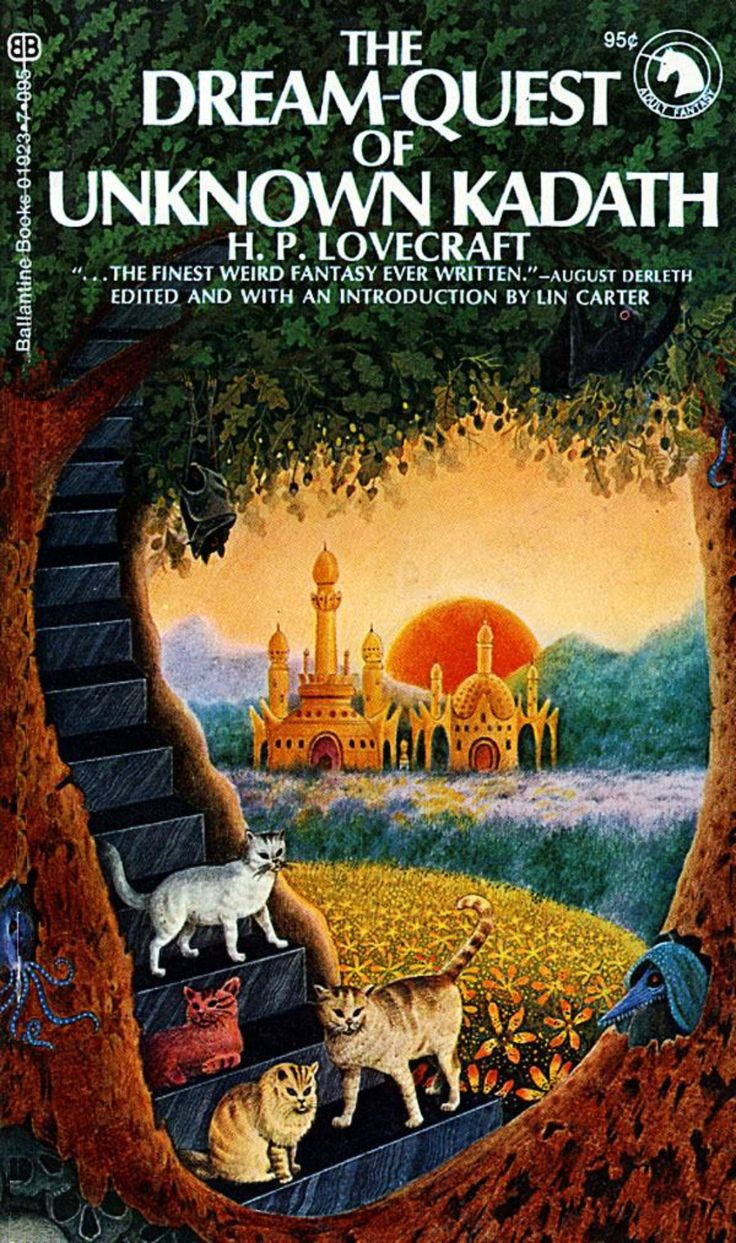
And here’s another Lovecraft story for you, although this does fit the description of a book a bit better, if only by a bit.
While Lovecraft was mostly known for what is called his ‘Arkham cycle’ (and yes, the asylum in Batman was inspired by him) which featured his famous monstrosities and was set in the ‘real world’, this book is part of his ‘dream cycle’, which is set in a dream dimension that is accessible to experienced dreamers and which lies parallel to the waking world. It’s essentially high fantasy but with his signature twists, and I must confess that I do prefer these stories over his more popular ones.
While this story has quite a lot of references to his earlier tales that a first-time reader may miss, it is a story that is more than capable of standing on its own. But what the flying fuck is the story about, I hear you ask?
The Dream-Quest of Unknown Kadath follows Randolph Carter, an experienced dreamer, who sees three dreams of a glorious ‘sunset city’ which he falls in love with, but into which he is denied entry by ‘The Great Ones’, the gods of the dreamlands. He must then descend into the dreamlands in an effort to find the forbidden and unknown castle of Kadath, upon which The Great Ones live, in an effort to convince them to let him visit and live in said city.
To Lovecraft’s credit, the story, like many pulp fiction books, is quite engaging. His idea of the dreamlands is so filled with adventure, and yet so very picturesque and Eden-like, that it is probably my favourite fantasy world. He was also a fellow feline enthusiast, meaning that the story is littered with cats, which always, ALWAYS gets a thumbs up from me.
But now comes the part I hate; critiquing and pulling apart a work that I love. Firstly, as you may have gathered from the last book, Lovecraft was a terrible racist and you can definitely see these undertones in his description of the dark, subhuman slaves of the Moon Beasts. The writing also seems quite childish at times, and I couldn’t help but feel that this was the sort of thing I would have written during my OLs. However, in his defence, the book was unpublished during his lifetime, and it’s possible that he would have liked to have edited it further before publication.
There is also one more glaringly obvious fault in this book, which is the almost comical lack of dialogue. The book is driven entirely by action and what little dialogue is present is often short and in the form of indirect speech rather than direct dialogue, that is to say, something like ‘he said X, to which she said Y, and then they talked about Z’. While he can get away with this in his short stories, the longer he drags out the tale, the more visible his lack of dialogue becomes. One can’t help but feel that here is a writer better suited to short stories.
Finally, and perhaps most unforgivably of all, the ending is a complete and total dud. It’s disappointing. It’s like biting into a biscuit and finding out that it’s gone all soggy and damp. I suppose I can’t really say much about this without spoiling the plot, but if you ever read this book, you’ll see what I mean. The final truth that Carter learns about his ‘sunset city’ seems masturbatory and self aggrandising on Lovecraft’s part, while the resolution to the final climax is a complete and cowardly cop-out, almost as if all his creative abilities had been used up during the rest of the book and he was forced to “pull a Chaucer” as I like to call it, and finish things off in whatever way that seemed easiest.
So, all things considered, the book was alright. It could have been better, but as long as you can bear a little disappointment in the final few pages, I wouldn’t advise against reading this, though I wouldn’t recommend it to anyone who wasn’t a hardcore Lovecraft fan either.
And if you’re wondering why I gave it a 7.8/10, it’s because of two things. One, the story up to the ending, despite its shortcomings, was actually pretty good and I thoroughly enjoyed it. And two, I’m terrible at rating things. To me, something is either good, bad, or ‘meh’. Apart from that, all numerical ratings are just random ‘guess-timates’.
But hey, it’s the journey that counts, and not the complete shit show of an ending that this man had the audacity to leave us with. Right?
Confessions of an English Opium Eater. (5/10)

Confessions is a rambling and needlessly long memoir by a man whose literary skills could not possibly have been made any worse by opium, although for reasons I cannot even begin to fathom, this book was all the rage when it was first published in its two parts.
Thomas De Quincey, an opium addict like many a man in Victorian England, wrote this memoir in two main parts; the first describes his formative teen years during which he was homeless and broke in London, which set the stage for the opium addiction that was to come later, and the second part describes “The pleasures of opium” and “The pains of opium”. Ironically enough, while the title means that a reader only picks up this book out of curiosity about the writer’s experiences with opium, it is the first half of the book that one finds interesting, rather than the actual discussions of opium.
While De Quincey’s friend and contemporary, the poet Coleridge, seems to have been inspired and fuelled by opium (although it did wreck his health), De Quincey was not so fortunate. He was completely unable to write for the most part and he even had to cancel a third part of this book that he had promised the public. But that of course has little to do with this book itself apart from providing some context.
The book does have a few good points. The tale of his early years is quite touching and makes an interesting read in its own right. He also does a good job of providing first-hand experience on the usage of opium and its pleasures and pains.
He lived a fascinating life and it’s these facts of his life that make the book interesting, rather than his own skill at writing. Indeed one can’t help but feel that the whole thing could have used a good editor to knock some sense into his writing. It’s also evident from his boasts that he thinks much of himself as a scholar, but De Quincey the scholar and De Quincey the writer can hardly be the same creature, for his writing is mediocre at its best and tedious at its worst.
He has the long-winded and apologetic tone that one comes to expect of Victorian writers, but this is not what is tedious about him. Here is a man who clearly didn’t know his own skills and strengths. He is constantly apologising for recounting his opium-induced experiences (the one part of the book that’s actually interesting) and doesn’t realise that it is his constant apologies and random but frequent tangents that actually make his writing insufferable.
All in all, it was disappointing and occasionally boring, and I would not recommend it to anyone. That is unless you’re considering taking heroin, in which case this is a pretty good warning. And remember kids, don’t do heroin. Do weed instead. :)
Selected Poems. W. B. Yeats. (8/10)

I don’t really know what I’m supposed to say about this book, except that it feels like folklore, green, love, and Ireland. Of course, it almost goes without saying that this review is of Yeats' poetry in general and so it applies to any collection of his poems, rather than just this particular edition.
Yeats was undoubtedly a great poet, one of Ireland’s finest, and his poetry is reflective of that. A devoted republican, his patriotism shines through in quite a few of his works such as ‘September 1913’ (one of my personal favourites). His treatment of Irish folklore, particularly in The Wanderings of Oisin, is also fascinating from an outsider’s perspective, though these poems are all coloured by his own personal views on both republicanism and the occult in a rather strange mix, for Yeats considered these folktales to be symbols of a patriotic Ireland, and yet he also believed in the supernatural and in the 'fair folk'. One can also sense the influence of Blake on his poetry, with whom he shared a fascination with the spiritual and metaphysical, though Yeats was not blessed with his artistic vision.
Apart from that, there’s really not much to say. Unlike many other poets, his works are rooted and set firmly in Ireland, though their themes may be universal. And yet, his poetry seems an essential and integral part of the progression of English literature through the centuries and is worth studying for anyone interested in English literature.
The Fairies in Tradition and Literature. (9/10)

Though it’s the only purely academic book here, Katherine Briggs does an excellent job at making the book both accessible and appealing to the average reader, and so I beg of you to stick with me on this, though it might not be a book of the sort that might usually interest you.
The ‘fair folk’, and perhaps nature spirits as a whole, have been an obsession of mine ever since I read a book of faery stories from folklore as a child, and so when I stumbled upon this book, I immediately picked it up. It is true that I was a little misled by the title, as I did hope that it would at least attempt the impossible feat of documenting faery lore from around the world. This the book does not do, focusing solely on the British Isles, though I can’t really blame Briggs for this. Covering the entirety of faery lore in the British Isles seems itself an impossible task, with folk tales and beliefs varying widely between regions.
Briggs was one of the most eminent folklorists of the British Isles and the quality of the work here is reflective of that. She doesn’t believe in the fair folk herself, in case you’re wondering. But she does treat her subject with such seriousness that she does often talk of the fair folk as if they were real things. Of course, what’s important to the folklorist isn’t what’s empirically real, but rather what people believe to be real.
And this book deals with just that, discussing the various types of faeries, the numerous folk theories regarding them, how these change between regions and over time, as well as how they were dealt with in literature. Still, the book was written for the average reader and you and I don’t need an academic interest in folklore to enjoy the book. It’s even filled with folk tales from various regions and deals with everything fae-related, from the ‘wee folk’ to dragons and wyrms, from playful pixies and brownies to malignant kelpies and fen spirits. Overall, the tone of the book is very friendly and not condescending in the least, making the whole thing a thoroughly enjoyable read.
If you are interested in the fair folk of the British tradition, folk tales, or just looking for a fun non-fiction book to break the monotony of reading only novels, this is most definitely the book for you.
Lives of the great composers. Volume 3 (7/10)

This one was a weird little book that I randomly picked up just because it looked so quaint. It’s not my cup of tea, but it was cool in an “I need to read more diverse shit, so I suppose I’ll read this” type of way.
(This is the last book for the month and all the interesting books you might want to read are done with, so feel free to duck out and skip the rest if you wish to.)
Being a Pelican book, the cover looks pretty and the book itself is quite old, and, to be completely honest, I’m more interested in the physical book itself than its contents. It just seemed a nice addition to my collection.
But moving on to the actual contents of the book, as the title suggests, it contains a series of biographies of great composers, each written by a different person. This volume focuses on Brahms, Wagner, and their contemporaries. And yes, I am aware that unless you’re into classical music, those names mean little. However, the book ostentatiously focuses on the artist rather than their music, so even if you’re not a fan of their music (I wasn’t either) the book makes for an interesting read, and the way their lives are narrated isn’t uninteresting.
Personally, I found it very valuable on two fronts. First, as an artist of sorts myself, it was intriguing to read about the lives and habits of successful artists. But perhaps more importantly, it helped me gain a rough mental map of the musical landscape during the 19th and early 20th centuries.
For example, before reading this, I thought of Wagner as ‘the famous opera dude’. Now, I tend to think of him as ‘the famous opera dude who was also a complete and total prick’. I also found that I do like the music of Dvorak and Elgar, which was a more positive realisation than the last one.
But perhaps the book’s greatest merit is that it’s engaging and readable even for someone who has zero interest in classical music.
So yes, all things considered, it was quite an enlightening book, and though it’s unlikely that you’ll ever come across this thrifted little treasure of mine, I recommend that you pick it up if you get a chance to.
Well, there you go. That was my reading list for June in no particular order.
I am new to reviewing books, so do forgive me if I violate some long-standing review tradition, or if the whole thing just seems like a hot mess.
But hopefully, you enjoyed this, or at the very least found it useful, and maybe, just maybe, all those years of studying English Literature served some purpose other than making me hilariously unsuitable for the job market.
Anywho, I hope I’ll see you glorious dipshits for the next review as well. Until then, stay weird, and say hello to the Eggman for me.


Comments